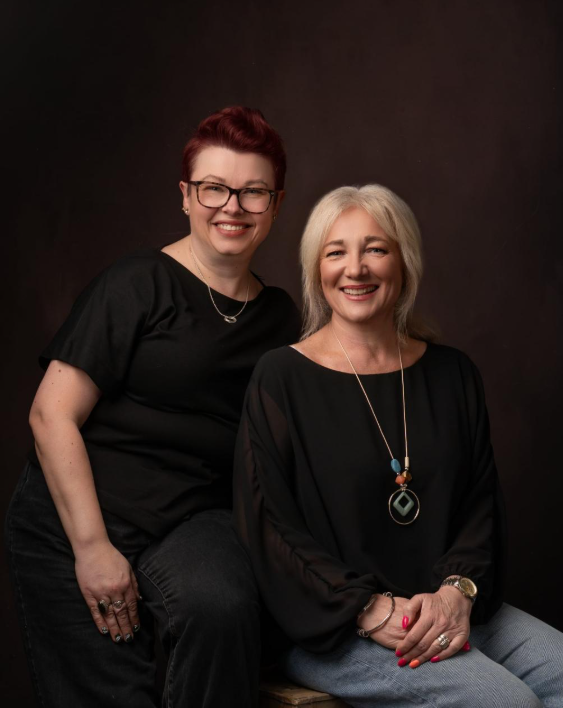
The village of Clydach in Swansea is based at the base of Swansea Valley. The beaches of Swansea to the South and the hills of Bannau Brecheiniog to the North. On the High street is a beautiful photography studio run by Jenny and a few doors away Zoe runs her fashion boutique within a pretty retail/gift shop. They wave and say hi to each other regularly and have chats when they call in to see each other. One day Jenny mentions numbness in her foot, Zoe mentions her numb thigh, when the words Cauda Equina are spoken they are both a little shocked to discover their common experience and emotionally share a hug. It is mentioned that 1-3 people per 100,000 experience CES and here they are literally just metres away from each other running their own businesses.
Read their story…
Jenny:
“My journey with cauda equina syndrome began long before I even knew what it was. At 16, right in the middle of my A-levels, I developed sciatica. One of my A-levels was dance, something I had hoped to pursue at university, but within months, the pain became unbearable. I spent the entire summer going back and forth to physiotherapy, trying desperately to manage it. Eventually, I had to finish school and find a job, setting aside my dreams.
Over the next few years, life carried on. I married my high school boyfriend, settled down, and gave birth to our daughter. Throughout all this, my back was manageable—I had occasional twinges, but nothing I couldn’t handle. Then, 12 years ago, everything changed.
My back pain worsened over several months, and nothing seemed to help. Pain management, osteopathy, and various treatments failed me. I kept hearing the term “cauda equina syndrome” and the warning: “Watch out if you start to have reduced feeling in your saddle area.”
In February 2013, over the course of one week, my whole life was turned upside down. My first trip to Accident & Emergency (A&E) was at the suggestion of Physio Direct. However, the doctor dismissed my concerns, stating that I was “too young” for such a condition. He ended our conversation with, “The osteopathy team will not see you unless your leg is falling off.”
That weekend, the pain became unbearable. I lost sensation in my bladder and bowel, I couldn’t lift one leg, and I found myself dragging it behind me as I walked. On the same day my daughter was starting nursery, my husband took me back to A&E. I will never forget the sight of her waving to me from the car while I hobbled into the hospital, terrified of what was to come.
When the doctors examined me this time, their expressions shifted from neutral to urgent. The words “cauda equina syndrome” were no longer just a vague warning; they were now my terrifying reality. They explained that my spinal cord’s nerve roots were being compressed, a medical emergency requiring immediate surgery. Without intervention, I risked permanent paralysis and loss of bladder and bowel function. The reality hit me hard. I was rushed into surgery at Heath Hospital in Cardiff, my mind a whirlwind of fear, hope, and uncertainty.
The procedure was successful, but the delay in operating left lasting damage. I was left with bowel and bladder weakness, as well as drop foot in my right leg. This changed my life completely—I had to leave my well-paid job as an accountant at an international steel company, and suddenly, I was left not knowing what to do next.
I guess this is when my life changed for the better in an unexpected way. During my recovery, I discovered my passion for newborn photography. What started as a creative escape soon became a new career path. I decided to start my own business as a photographer and eventually settled into my very own studio on a local High Street. 10 years later I am still running that business after photographing over 500 babies.
It was then by chance that I met Zoe, who runs a local gift shop. We were chatting about menopause and our numb bits, and then both spoke the words—literally at the same time—”cauda equina syndrome.” For something that is deemed to be a rare occurrence, that now makes two people in my life who have had the same condition as me. My dad was also diagnosed and operated on 5 years ago.
Cauda equina syndrome changed my life, but it also reshaped my perspective. I learned the importance of listening to my body, of advocating for my health, and of finding strength even in the darkest moments. My journey is far from over, but each step forward—no matter how small—is a victory.
To anyone facing this condition, know this: you are not alone. The road is difficult, but recovery is possible. And sometimes, the greatest strength comes from the struggles we never expected to face.”
Zoe:
“I felt a pop in September 2019 and suffered typical sciatic pain for months. Osteopath appointments didn’t help and the pain got worse. Bending and lifting in the shop (at this point I worked alone 6 days a week) was excruciating and looking back at photos I can see how uncomfortable I was, it’s just written all over my face. I saw a muscular skeletal consultant in January 2020 who after telling me I was fit and healthy briefly said that should I experience any loss of sensation in saddle area to go straight to A&E although he was 95% sure it wasn’t Cauda Equina, this was the first mention of those words. By March it was even worse, I would go to bed in tears and spend my days in work on the edge of just collapsing into a heap. One night I got up to go to the loo and couldn’t feel the right side of my saddle area and the consultant’s words came back to me and we promptly went to A&E. This was Sunday 15th March 2020. After a basic check over and a bladder scan I was sent home. Although I was suffering with retention the nurse wasn’t concerned and just said “if the numbness spreads come back”. Tuesday 17th March 2020 I locked my shop where I had been since 2013 for the last time. That night I lost saddle sensation completely and returned to A&E.
This was all during the very start of covid and A&E was not a good place to be. However, the staff were fabulous and I was fully assessed and had an MRI early the next morning. My husband kept telling me to let them take over and release myself into their care – it was a complete daze. By the time the surgeon came to see us it was about 10am and I was 2nd on the surgery list for the day. He diagnosed CES and that my surgery was non elective. It was so scary but I just let a calmness come over me – my poor husband nearly fainted and had to lay on my hospital bed!
My surgery was carried out around mid-day on Wednesday 18th March and was approx. 6/7 hours long, my l5/S1 disc had completely broken into pieces and took a long time to extract with some bits left floating about in me. I have fleeting memories of lovely nurses getting me on a bed pan, giving me drugs and feeding me hospital sandwiches. On the Thursday morning I was helped to sit up. I managed to stand and walk with a frame the 5 or 6 steps to the toilet. This was the first time my chin wobbled with a realisation of what had happened. They wanted me out as soon as possible as the ward I was on had been selected as a covid ward. I remember the chaos as staff were frantically trying to move people who needed to stay. As my husband arrived to ‘visit’ on the Thursday afternoon I told him I was coming home. It was a bit quick but it was the best thing for me.
I was home on Thursday 19th March by the evening and then lock down happened. I have never seen a physiotherapist and I have never spoken to a consultant in urology, bowel care, neuro or pain control. My husband kept me away from googling CES and I concentrated on my own recovery. I walked 20 metres on that first weekend and slowly built this up day by day. My friend’s husband is an ODP and he came to the house to remove my staples and my husband proved to be a most excellent wound care specialist. There are so many funny moments during recovery (which I know sounds odd) and I think of those moments now more than the scary stuff. Lots of things went wrong in the house and I have no idea how I just saw the funny side of being pot washed in the shower by my husband as our boiler had broken. I am exceptionally lucky. Yes, there are days I am rubbish, my feet and toes do weird things and I can’t kneel down properly anymore but I am mobile and strong. I set myself a goal of getting up Pen Y Fan mountain by my 50th birthday in the July of 2020 – I actually did that in the June.
When Jenny and I discovered our connection it was a bit weird to think there we were just doors away from each other running our businesses on the same High St. We have both had a different journey but I know if it wasn’t for people like Jenny who went before me my treatment would not have been so speedy. The surgeon and the ortho team acted immediately and I thank them for their diligence. I think its important to get the positive stories out there for the newly diagnosed and those recovering from surgery. I try to keep positive on the group page, everyone’s journey is different and the best thing I did was carry out my own recovery at my own speed. There’s not a lot to be thankful to covid for but having to close my shop due to lockdown ensured my focus was on me and my recovery and not worrying about my business. Everyone was closed not just me. 5 years on I don’t feel a wobble on the anniversary, I focus on the fact that I can jog a little, I can walk a lot and I can carry on running my business. It’s changed a bit as I am now in a shared space with fabulous work colleagues who each run their own enterprises and the only thing I know I need to re visit is what I missed for my 50th birthday!
We both appreciate you reading our stories and hope that it brings some positivity and hope to those just starting their journey through CES and recovery. Keep strong everyone.”
Jenny Macdonald’s business https://mcdonnellphotography.co.uk/
Zoe’s business https://www.niftyandco.co.uk/collections/all